Health and Safety Policy — House Clearance Westminster
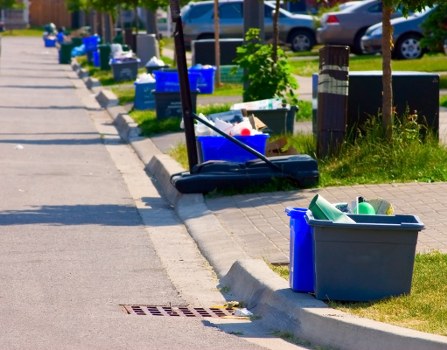 Purpose: This Health and Safety policy sets out the principles and controls applied by our house clearance and rubbish removal teams to manage risk during clearances. It is written to be applicable across our service area and to support safe, compliant waste clearance operations without over-specifying local arrangements. The document is intended for staff, contractors and authorised visitors involved in house clearance services and waste management activities.
Scope and commitment
We commit to implementing safe systems of work for every house clearance, waste clearance and rubbish collection job. This includes routine domestic clearances, bulky waste removals and complex clear-outs that may involve hazardous materials. Our approach is preventative, proportionate and reviewed regularly to reflect changes in legislation, industry practice and operational learnings.
 Key objectives include:
- Protecting staff, contractors and the public from injury and ill-health.
- Ensuring safe handling, segregation and transport of rubbish and recyclable materials.
- Maintaining clear procedures for hazardous waste identification and transfer.
- Reducing environmental impact through responsible disposal and reuse.
Roles, responsibilities and organisational arrangements
All personnel engaged in house clearance activities share responsibility for health and safety. Management will:
- Provide training, equipment and supervision necessary to carry out safe clearances.
- Ensure risk assessments and method statements are prepared for high-risk tasks.
- Monitor compliance and investigate incidents to prevent recurrence.
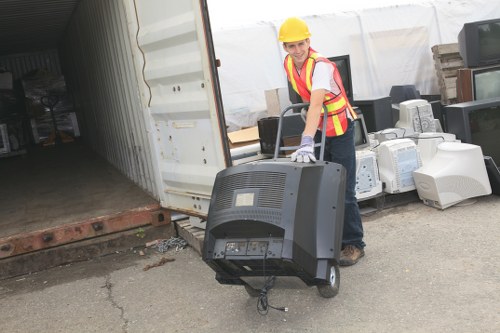 Employees and contractors must follow site-specific instructions, use issued personal protective equipment (PPE) and report hazards promptly. Anyone carrying out manual handling, operating loading equipment or dealing with potentially contaminated items must be competent and authorised.
Training and competence
Training is provided for manual handling, safe lifting techniques, use of mechanical aids, correct segregation of waste streams and identifying asbestos, sharps or chemical contamination. Refresher training is scheduled periodically and whenever procedures change. Team leaders are responsible for confirming competence before assigning solo tasks.
Risk assessment and safe systems of work
Prior to each assignment a documented risk assessment is completed covering site access, ground conditions, structural hazards, presence of vermin, sharps, liquids and potential hazardous household waste. Risk control measures may include exclusion zones, signage, mechanical lifting aids, and controlled segregation of recyclables and non-recyclables.
 Safe equipment use: Vehicles and lifting devices are inspected daily and maintained in accordance with manufacturer guidelines. Fuel, lubricants and other operational consumables are stored securely. Electrical equipment is PAT tested where applicable and removed from service if any defect is found.
 Personal protective equipment provided includes gloves, high-visibility clothing, safety boots, eye protection and respiratory protection where dust or biohazard risk is identified. PPE standards are reviewed and upgraded when necessary. Staff are required to wear PPE consistently while on site.
Hazardous materials and waste transfer
Some house clearances involve hazardous items such as asbestos-containing materials, batteries, solvents, medical waste or sharps. These items are identified in the risk assessment and managed in line with statutory requirements, including secure packaging, labelling and transfer to authorised carriers. We maintain records of hazardous waste movements and ensure duty of care documentation accompanies all transfers.
Incident reporting and emergency procedures
All incidents, near-misses and exposures must be reported immediately. Emergency procedures include first aid arrangements, spill control, and escalation to emergency services when necessary. We carry out investigations to identify root causes and implement corrective actions.
Monitoring and continuous improvement: Regular audits, toolbox talks and reviews of incident data inform improvements to our house clearance and rubbish company operations. Performance indicators include incident rates, training completion, equipment inspection compliance and successful waste transfer documentation. We aim to reduce risks and enhance safety culture across our service area without providing specific local contact details on this legal policy page.
Health, wellbeing and welfare
Worker wellbeing is integral to operational safety. Schedules are planned to avoid excessive fatigue, appropriate breaks are enforced, and access to potable water and rest areas is provided. Staff with health conditions that may affect safe task performance must notify management confidentially so suitable adjustments can be made.
Legal compliance and review
This policy aligns with relevant health and safety legislation and industry best practice for house clearance, waste removal and rubbish collection activities. It is reviewed at least annually and whenever there is a significant change in operations, legislation or after a serious incident.
Commitment: We are committed to delivering safe, responsible and professional house clearance services across our service area, minimising harm to people and the environment while ensuring compliance with legal requirements. This policy is authorised by senior management and is effective until superseded by an updated version.